8 October 2026
Five years on, what has AUKUS cost Australia’s strategic independence?
Chen Hong writes in the Global Times that, five years after AUKUS was unveiled, Australia has little to show for what was presented as a historic transformation of its defence capability — with the nuclear-powered submarines at its centre still years, and in some cases decades, away — and asks whether Australia has locked itself into a strategic architecture whose political and security costs are materialising long before its promised military benefits.
Read Article →
8 October 2026
Who gets to have an opinion on the AUKUS nuclear submarine military base?
Jeremy Lasek reports on questions raised at a Wollongong City Council meeting about a potential AUKUS submarine base on Australia’s east coast, with Port Kembla listed as the most cost-effective option in a three-year-old state government report, including whether council has a formal position and whether elected councillors will have input into future decisions.
Read Article →
7 October 2026
US to spend billions on new shipyard for AUKUS submarines
Michael Koziol reports that the US will build a new Baltimore shipyard to make components for the Virginia-class submarine — the kind Australia is due to acquire under AUKUS — to ramp up lagging production of the nuclear-powered boats, with President Trump announcing US$6.6 billion (A$9.5 billion) in government and private funding.
Read Article →
4 October 2026
Hegseth calls US-built nuclear submarines the ‘apex predator’ of the seas. But are they right for Australia?
Ben Doherty examines US Secretary of Defense Pete Hegseth’s description of the Virginia-class submarine as the “apex predator of the undersea domain”, and asks whether it is the right submarine for Australia, which is set to buy three of the boats second-hand from the US Navy beginning in 2032.
Read Article →
29 September 2026
A Nation's Morals Matter. AUKUS Shows Pandering to America Is Our Higher Priority
Albert Palazzo writes that AUKUS has already generated significant opportunity costs — an enormous budget at the expense of greater investment in education and medical services, a priority housing build for American military personnel even as Australians struggle to find housing, and a target on the nation's back in the event of a Sino-US war — and argues that, beyond these failings, the program also falls short on a more basic measure: national integrity and doing the right thing.
Read Article →
24 September 2026
Albanese, AUKUS and the Broken Promise on Nuclear Weapons
Tilman Ruff writes that as Albanese receives an international award for his leadership on security, Australia remains outside the nuclear weapons ban treaty he once championed. Meanwhile, expanding US military access raises new questions about Australia's exposure to nuclear conflict.
Read Article →
15 September 2026
What Has AUKUS Pillar II Achieved Over 5 Years?
Kester Abbott and Tara Luckock write that Pillar II's progress has proven difficult to judge — not due to a lack of activity, but because there's no agreed metric for what success should look like.
Read Article →
21 September 2026
AUKUS Assurances Collide With the Reality of Britain's Submarine Fleet
Peter Briggs writes that while British officials insist AUKUS remains on track, serious pressures across UK submarine availability, design and reactor production — alongside continuing US shipyard delays — raise questions about the assumptions underpinning Australia's nuclear-powered submarine plan.
Read Article →
20 September 2026
Named as an Enemy: Indonesia's Uneasy AUKUS Moment
Maria Siow reports that a former Australian official's use of a hypothetical "aggressive Indonesia" to make the case for AUKUS at the Public Inquiry has been called "clumsy diplomacy" by analysts, who say the comments risk reviving old suspicions as Jakarta and Canberra try to strengthen security ties. Michael Pezzullo, a former deputy secretary of strategy in Australia's defence department, made the remarks in testimony on 2 September, using Indonesia as an illustrative adversary in a hypothetical conflict scenario.
Read Article →
19 September 2026
Disturbing Admissions From US Republican Congressman
Paul Keating writes that US submarines at HMAS Stirling, B-52 rotations through Tindal and deepening military integration are tying Australia ever more closely to US strategic priorities — including the prospect of war with China over Taiwan.
Read Article →
16 September 2026
Why AUKUS Makes War More Likely — and Australia's Actions Could Precipitate Catastrophe
Crikey examines how AUKUS increases the likelihood of Australia being drawn into a US-China conflict, arguing the pact's logic makes catastrophic escalation more probable rather than less.
Read Article →
16 September 2026
AUKUS Endures Extraordinary Political Change as It Reaches Fifth Anniversary
In this opinion piece, Jennifer Parker argues that successive governments across all three AUKUS countries have concluded the nuclear-powered submarine technology partnership serves their national interests, and that as the pact reaches its fifth anniversary, a strong navy has never been more important for Australia.
Read Article →
12 September 2026
Rockingham Braces for AUKUS as Local Leaders Say Community Resources Already Stretched
With the arrival of the first AUKUS nuclear-powered submarine and associated personnel less than 400 days away, Rockingham Mayor Lorna Buchan says the area near HMAS Stirling is already experiencing strong population growth, and the council is wondering how it will cope with the influx of service people, their families, and increased demand on already strained infrastructure.
Read Article →
9 September 2026
Paul Keating's AUKUS Hostility Reflects His Passion for Hard-Nosed Realism Over Subservience
For Keating, AUKUS lacks the hard-nosed realism his critics say is his defining foreign policy trait, instead representing a return to false security through subservience to the US and to the arms of the United Kingdom. For critics like Keating, this isn't just an abrogation of sovereignty — it's a failure to practise realism, which demands Australia seek its security in Asia, rather than from it.
Read Article →
24 August 2026
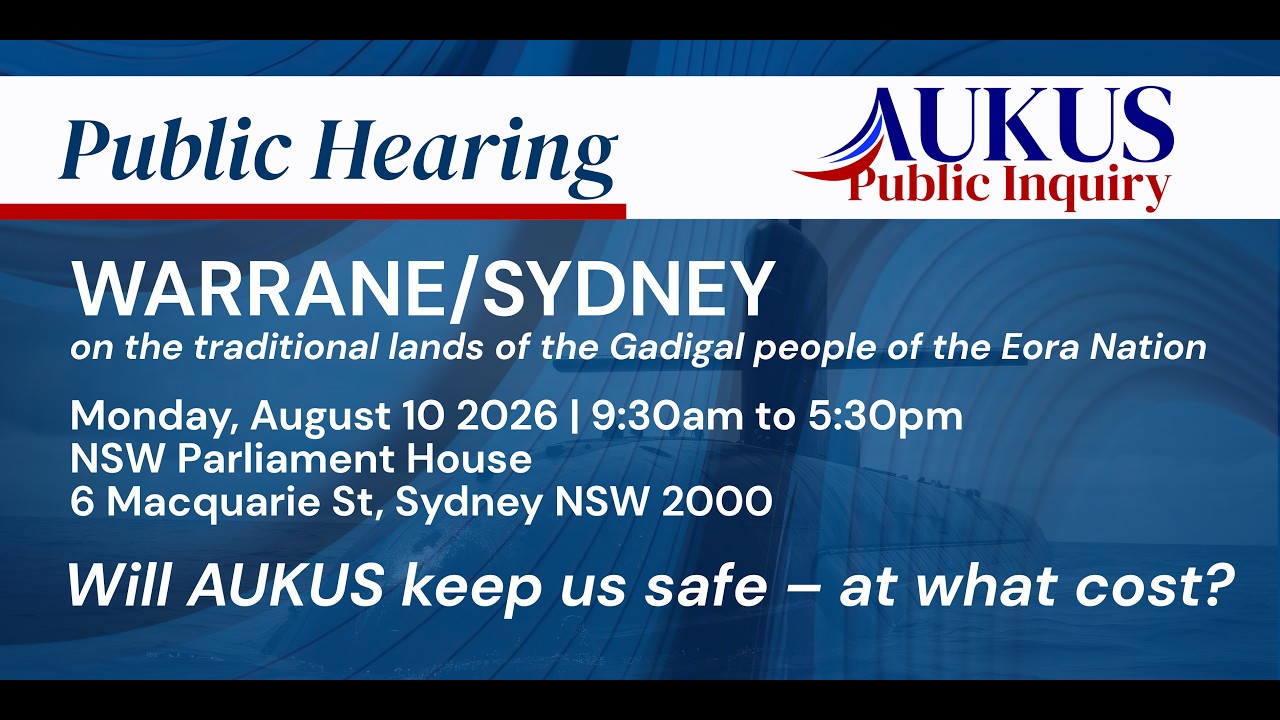
AUKUS Money Would Be Better Spent on Public Education, Housing, Skills Crisis
NSW Teachers Federation Deputy President Natasha Watt told the Sydney hearing of the AUKUS Public Inquiry that the $368 billion-plus commitment to nuclear-powered attack submarines is the wrong use of Australia's taxes. "As teachers, we work daily with the consequences of underinvestment in public services," Ms Watt told the inquiry.
Read Article →
8 September 2026
Australia Can't Afford to Go It Alone on Defence, Kim Beazley Tells AUKUS Inquiry
Former defence minister Kim Beazley expects the United States to deliver its promised Virginia-class submarines to Australia, arguing the country cannot afford to go it alone and would be left "substantially deafened and blinded" without the alliance.
Read Article →
7 September 2026
Does the Public Really Support AUKUS? Or Are We Asking the Wrong Questions?
Crikey's Wanning Sun examines how the wording of survey questions — and the public's access to information — significantly shapes what polling actually reveals about sentiment on the submarine pact.
Read Article →
7 September 2026
Could the US Drag Us Unwillingly Into War? — Podcast
A special Guardian investigation reveals the breadth of the US military presence dotted around Australia's coastline, with some analysts warning it represents a "saturation" or "colonisation" of the continent. Senior reporter Ben Doherty speaks to Reged Ahmad about whether that presence could drag Australia unwillingly into war.
Listen Here →
4 September 2026
Shoebridge Slams AUKUS, Says It Is ‘Inviting War’ Onto Australian Soil
The AUKUS security agreement is an extraordinary and deep betrayal of Australia's national interests and will invite the frontline of the next great war onto our doorstep, an independent inquiry into the deal has heard.
Read Article →
3 September 2026
AUKUS Makes Australia a Nuclear Target, Top Experts Warn
Australia is significantly more likely to be dragged into a destructive conflict with China — and potentially targeted with nuclear weapons — under AUKUS, two former senior national security figures have warned. Michael Keating, a former Department of the Prime Minister and Cabinet secretary, and former public servant Jon Stanford argue the government's current defence posture has "sacrificed considerable sovereignty" to the United States.
Read Article →
23 August 2026
Dump AUKUS Subs for Undersea Drones, Says Former ADF Officer
Adam Leslie, a former Australian military officer running the Washington-based think tank The Alliance Futures Initiative, argues Australia should abandon the AUKUS submarine purchase to avoid duplicating capabilities already held by allies, and instead invest in undersea drones, missile testing, and critical minerals.
Read Article →
16 June 2026
Here Is the $368b Question Nobody Wants to Ask About AUKUS
Former Chief of the Australian Defence Force Chris Barrie argues that if AUKUS is the right answer for Australia, it will withstand examination — and if it cannot, that is something Australians need to know now, not in 2035.
Read Article →
2 September 2026
AUKUS Is Heading for the Rocks: Why Australia Must Pivot to a Sovereign LEU Submarine Fleet
John Menadue's Peter Briggs argues that US production shortfalls, Britain's submarine crisis and Australia's own infrastructure delays are eroding the assumptions behind AUKUS, and that it's time to take a different path: a $368 billion gamble Australia does not need to take.
Read Article →
19 August 2026
AUKUS Only Works if Britain's Submarine Town Does
Politico's Ryan Heath and Mason Boycott Owen report from Barrow-in-Furness, England, where the BAE Systems shipyard must deliver AUKUS submarines at an unprecedented pace even as the town repairs decades of underinvestment in housing, skills and public services.
Read Article →
19 August 2026
AUKUS Pillar One, Part Two: The Nuclear Dilemma – Acquiring a Sustainable, Sovereign Undersea Capability
Pearls and Irritations' Jon Stanford and Michael Keating examine the nuclear dilemma at the heart of AUKUS Pillar One, questioning whether Australia can realistically acquire a sustainable, sovereign undersea capability under the current arrangement.
Read Article →
19 August 2026
This Small Town Has Raised Questions on AUKUS That Every Australian Should Consider
Cheek Media Co.'s Bernadette Clarke reports from Port Kembla, where residents are pushing back on the suburb becoming the east coast's submarine base, including victim-advocates raising safety statistics and teachers concerned for their students.
Read Article →
15 August 2026
AUKUS: ‘It Will End When the United States Pulls Out’
On this fortnightly Australian Foreign Affairs discussion, Sam Roggeveen and Hugh White examine how the Treaty of Rarotonga's ban on stationing nuclear weapons in the South Pacific may collide with planned US nuclear-armed submarine rotations through HMAS Stirling from 2032.
Watch Now →
14 August 2026
AUKUS: The Inquiry Canberra Refused to Hold
Michael West Media's Andrew Brown notes that Australians crowdfunded a citizens' inquiry into the $368 billion AUKUS deal after both major parties declined to hold a formal parliamentary inquiry, with the crowdfunded process now drawing testimony from former ministers, a former Defence Force chief, and a former WA premier.
Read Article →
14 August 2026
Global Roaming – Peter Garrett Puts AUKUS on Trial: Is It a Rip-Off?
ABC's Global Roaming with Geraldine Doogue and Hamish Macdonald offers a critical examination of AUKUS through the lens of the public inquiry, highlighting concerns about cost, risk, and democratic accountability.
Listen Here →
12 August 2026
The Anti-AUKUS Campaign Needs to Turn Into an Effective Political Movement
Crikey's Wanning Sun argues there is no shortage of compelling arguments against AUKUS, but that they haven't yet coalesced into a "narrative" reaching beyond the people already inclined to oppose the submarine pact.
Read Article →
11 August 2026
‘Bleak Future’: AUKUS Inquiry to Hear Fear of Exclusion Zones at Port Kembla Beaches
The Illawarra Mercury's Ben Langford reports that a Port Kembla mother and anti-nuclear activist fears for the future of her hometown and her children if the suburb becomes the site of a US-Australian nuclear submarine base.
Read Article →
10 August 2026
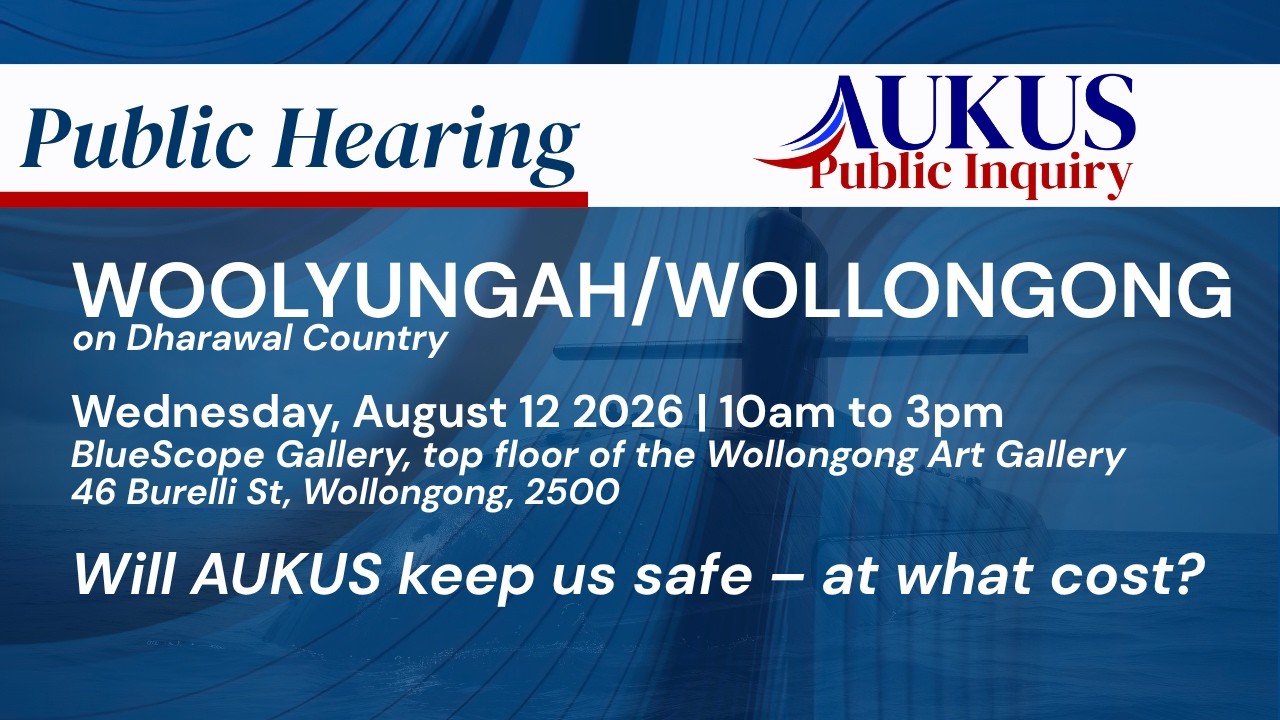
Independent AUKUS Public Inquiry Hearing Coming to Wollongong
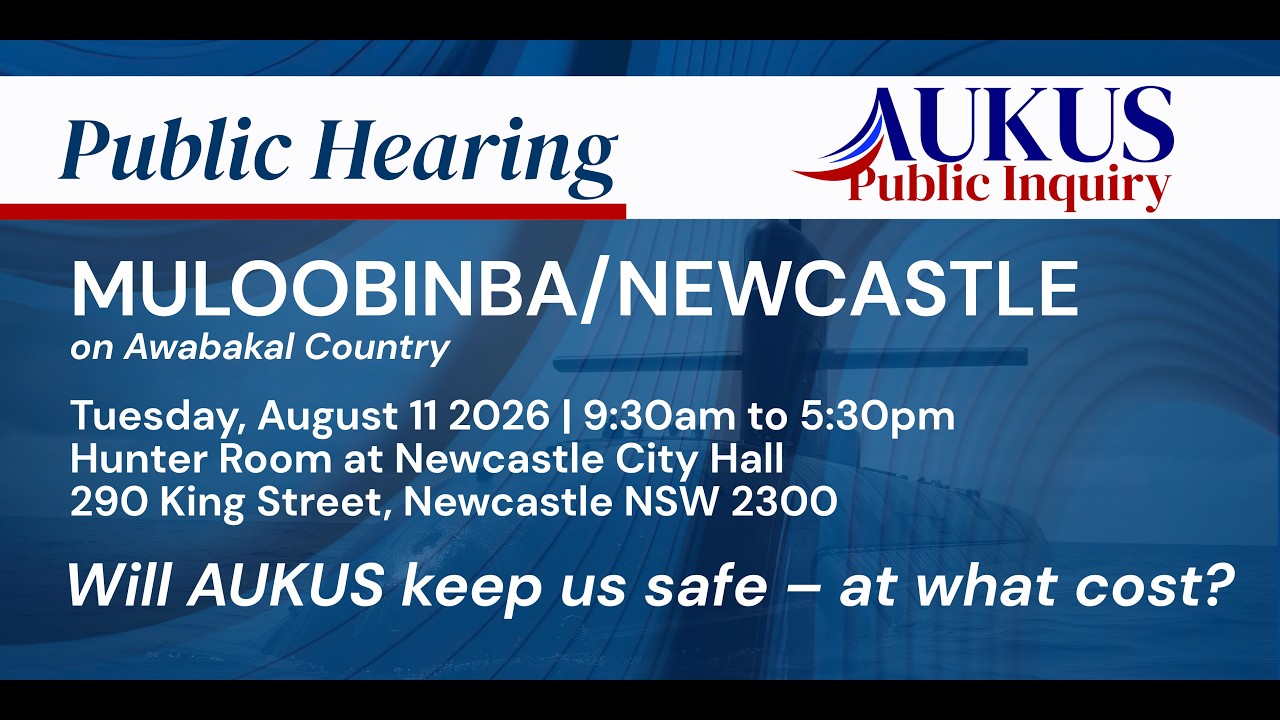
Region Illawarra's Andrew McLaughlin reports that hearings into Australia's participation in AUKUS are set to resume in Sydney, Newcastle and Wollongong after a series of hearings held in southern and western states.
Read Article →
10 August 2026
Ex-Prime Minister Warns AUKUS Deal May Not Deliver
SBS News reports that Malcolm Turnbull told the crowd-funded public inquiry, led by Peter Garrett and a former ADF chief, that of the three AUKUS partner nations Australia's parliament has the most at stake but is the "least curious and the least informed."
Watch Now →
10 August 2026
Malcolm Turnbull Says Faith in AUKUS Nuclear Submarines Deal Is “Stark Staring Bonkers”
The Guardian's video coverage of the AUKUS Public Inquiry captures former Prime Minister Malcolm Turnbull's testimony questioning the basis for confidence in the submarine deal.
Watch Now →
10 August 2026
‘Highly Unlikely’: Turnbull Says Australia Might Not Get Any AUKUS Subs
Crikey's Anton Nilsson reports that former Prime Minister Malcolm Turnbull told the independent inquiry into AUKUS that the pact could end up being a historic defence planning failure.
Read Article →
10 August 2026
Former PM Questions US Deal to Deliver AUKUS Submarines
The Canberra Times' Tess Ikonomou reports that Australia faces the real risk of not receiving its promised nuclear-powered submarines under AUKUS, as former Prime Minister Malcolm Turnbull told the inquiry it is unlikely Virginia-class submarines will be delivered while the US Navy continues to fall behind on its own production.
Read Article →
7 August 2026
Richard Marles Says America, Not Australia, Will Decide How Long AUKUS Subs Remain at HMAS Stirling
The Nightly's Andrew Greene reports that Defence Minister Richard Marles says the United States, not Australia, will determine how long its nuclear-powered submarines remain at HMAS Stirling, based on American operational requirements.
Read Article →
6 August 2026
Peter Garrett on What the Public Thinks of AUKUS
Brought to you by ABC Radio National, presented by David Marr on Late Night Live, Lead Commissioner Peter Garrett discusses the AUKUS Public Inquiry, which has now received over 600 submissions including from former ministers Gareth Evans, Linda Reynolds and Christopher Pyne, as the Inquiry heads to Sydney hearings featuring former PM Malcolm Turnbull and former Foreign Minister Bob Carr.
Listen Here →
3 August 2026
AUKUS Infrastructure, Part 6: It Is Not Too Late to Change Course
In the final instalment of a six-part series for Pearls and Irritations, Peter Briggs argues AUKUS Pillar One cannot deliver on schedule or budget, and that Australia should pause its HEU pathway and assess proven LEU alternatives.
Read Article →
2 August 2026
AUKUS Infrastructure, Part 5: The HEU Problem
Peter Briggs examines Australia's choice of highly enriched uranium for AUKUS submarines, raising questions of proliferation, safety, waste, regulation, and the civil burden placed on Australian shipyards.
Read Article →
1 August 2026
AUKUS Infrastructure, Part 4: Australia's Dual-Site Labour Trap
Peter Briggs turns to workforce, arguing Australia must build and sustain two geographically separated nuclear submarine hubs despite acute skills shortages, certification bottlenecks, and competition from the resources sector.
Read Article →
31 July 2026
AUKUS Infrastructure, Part 3: The Osborne Construction Enterprise
Peter Briggs finds that while Osborne's submarine yard is making visible progress, unfunded stages, nuclear licensing, supply-chain dependence and the absence of an embedded graving dock pose major risks.
Read Article →
30 July 2026
AUKUS Infrastructure, Part 2: The Henderson Bottleneck
Peter Briggs turns to Henderson, where fragmented land tenure, commercial disruption and regulatory delays could block the facilities Australia needs to sustain nuclear-powered submarines.
Read Article →
30 July 2026
Labor's Controlled Conference Avoided the Questions That Matter
Margaret Reynolds argues the ALP's 50th National Conference in Adelaide should have tested the government's reform record and commitment to international law, but factional control turned it into a managed exercise in avoidance.
Read Article →
29 July 2026
AUKUS Infrastructure, Part 1: The Docking Gap That Could Sink Pillar 1
The first in a six-part series for Pearls and Irritations, Peter Briggs examines the maintenance reality behind AUKUS Pillar One, and the looming risk that Australia may receive Virginia-class submarines before it has certified infrastructure to dock and sustain them.
Read Article →
23 July 2026
Labor Has a Proud History of Debate. So Why Won’t It Interrogate the $368bn Aukus Pact?
Peter Garrett: Despite substantial reservations about the submarine deal, it’s unlikely to be seriously examined at the ALP national conference.
Read Article →
21 July 2026
AUKUS Is Being Exposed, But Will Anything Change?
Writing for Pearls and Irritations, Justice and Peace Facilitator Julie Macken reflects on weeks of Inquiry testimony — from Linda Reynolds’ admission that Fremantle would become a bigger nuclear target, to warnings of an unplanned nuclear accident response — and asks whether the evidence will actually shift government policy.
Read Article →
20 July 2026
Peter Garrett Talks Music, Protest and the People’s Inquiry into AUKUS
In a ChangeMaker Chat episode, Lead Commissioner Peter Garrett discusses his decades of activism and explains how the AUKUS Public Inquiry is creating space for the public debate that Parliament has not had on the $368 billion submarine deal.
Read Article →
18 July 2026
Christopher Pyne Declares AUKUS ‘Unstoppable’, Says Parliament Shouldn’t Vote on It
Former Defence Minister Christopher Pyne told the Adelaide hearing that decisions on AUKUS should sit with the National Security Committee of Cabinet, not Parliament, while conceding the program is unlikely to be delivered on time or on budget.
Read Article →
18 July 2026
‘Height of Unfairness’: Former SA Senator Slams Government Over AUKUS Nuclear Waste Move
Rex Patrick tells news.com.au the Federal Government is fighting to keep secret its own advice on where AUKUS nuclear waste will be stored, and says he is considering Federal Court action after three Freedom of Information requests were refused.
Read Article →
16 July 2026
AUKUS Will Not Run on Time or On Budget: Christopher Pyne Says
The Sydney Morning Herald reports on former Defence Minister Christopher Pyne’s evidence to the Adelaide hearing, in which he acknowledged AUKUS is unlikely to be delivered on schedule or within budget, but argued national security remains the more important priority.
Read Article →
30 June 2026
Former WA Health Chief Warns AUKUS Inquiry of ‘Nuclear Disaster Waiting to Happen’
The Point reports on Dr Colin Hughes’ testimony at the Fremantle hearing, warning that there is no nuclear safety plan for communities around HMAS Stirling in the event of a major accident.
Read Article →
29 June 2026
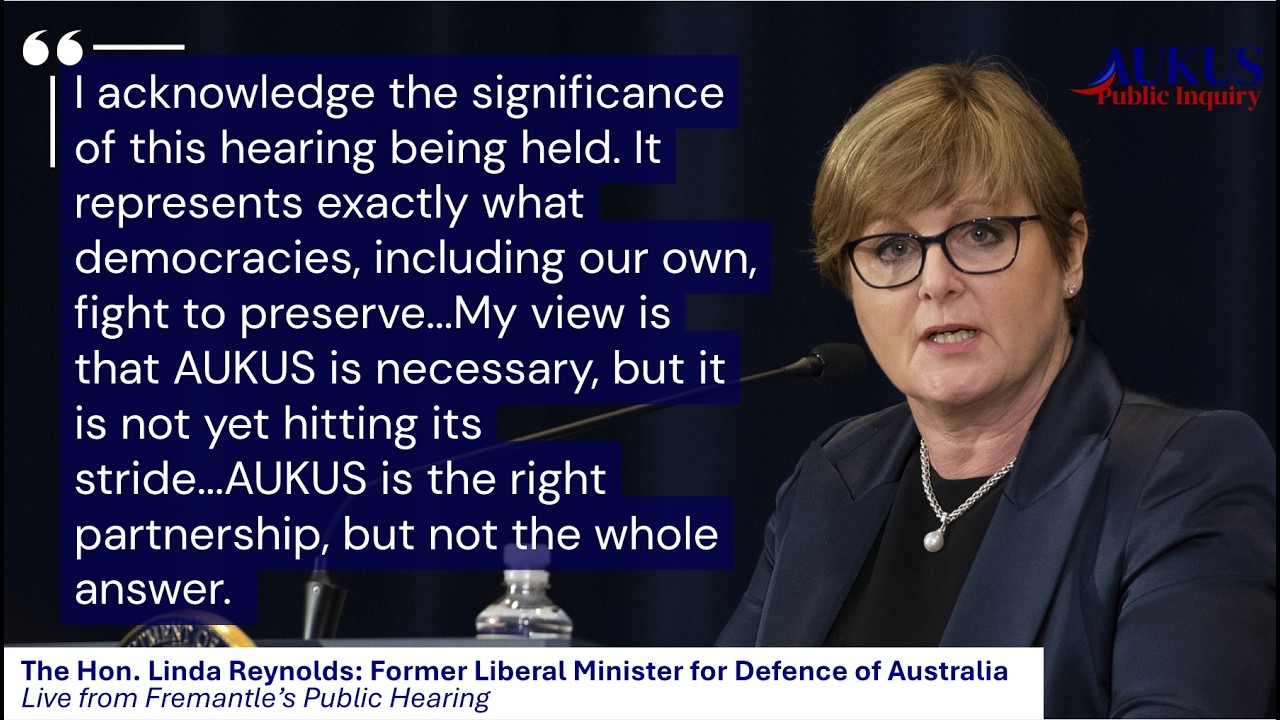
Linda Reynolds Defends AUKUS, Argues Australia Has No Credible Alternative
The Point covers former Defence Minister Linda Reynolds’ testimony at the Fremantle hearing, where she argued Australia has been in a ‘hybrid and grey zone war’ with China and that no credible Plan B to AUKUS has been proposed.
Read Article →
28 June 2026
‘Twisted Steel, Shattered Structures’: AUKUS Inquiry Warned of Nuclear Disaster Risk
The Sydney Morning Herald reports on expert testimony at the Fremantle hearing warning of the risks of a nuclear accident at HMAS Stirling, and the absence of adequate emergency planning for surrounding communities.
Read Article →
12 June 2026
Truth Submerged? AUKUS Will Cost Us $368 Billion, So This Is No Time for Secrecy
Op-ed by Commissioner Dr Carmen Lawrence AO in the Sydney Morning Herald, arguing that the massive cost and strategic implications of AUKUS demand full public transparency.
Read Article →
11 June 2026
AUKUS Among Australia's Worst Foreign Policy Decisions — Gareth Evans
The Guardian reports on Gareth Evans' testimony at the Melbourne hearing, where he argued AUKUS Pillar One is "more likely than not" to prove one of Australia's worst defence and foreign policy decisions.
Read Article →
11 June 2026
AUKUS Deal Slammed as "One of Worst Policy Decisions"
The Canberra Times reports on Gareth Evans' assessment of the AUKUS deal at the first public hearing, calling for a government fallback plan in case the submarine fleet is not delivered.
Read Article →
11 June 2026
China Daily Asia: AUKUS Public Inquiry Opens in Melbourne
China Daily Asia covers the opening of the AUKUS Public Inquiry in Melbourne, reporting on the testimony of expert witnesses and the growing public debate over the submarine deal.
Read Article →
11 June 2026
Public Inquiry into AUKUS Is a Landmark Moment in Australia's Politics
UTS News argues that the independent public inquiry into AUKUS represents a landmark moment in Australian democratic accountability, bringing transparency to one of the most consequential defence decisions in the nation's history.
Read Article →
11 June 2026
The Folly That Is AUKUS
Richard David Hames on Substack examines the strategic, financial, and sovereignty failures at the heart of the AUKUS agreement, arguing the deal reflects a deeper failure of Australian independent thinking.
Read Article →
5 June 2026
Media Release: Australia wants a Public Inquiry into AUKUS!
Over $85,000 raised and 100+ written submissions received in the first 72 hours. Public hearings confirmed for Melbourne, Fremantle, Adelaide, Sydney, Port Kembla and Canberra.
View ↗
5 June 2026
Would You Buy a Used Submarine from Pete Hegseth?
The Sydney Morning Herald examines the implications of Australia's reliance on the US for nuclear-powered submarines amid shifting American defence priorities.
Read Article →
5 June 2026
Triple J Hack: Public Inquiry into AUKUS
ABC Triple J Hack covers the launch of the public inquiry into AUKUS, examining what the deal means for young Australians and why the inquiry matters.
Read Article →
3 June 2026
Peter Garrett to Lead Long Overdue Public Inquiry into AUKUS
The Point reports on the launch of the independent public inquiry, with Peter Garrett named as Lead Commissioner alongside four other eminent Australians.
Read Article →
3 June 2026
BBC: Australian Ex-Minister Launches Crowd-Funded Inquiry into AUKUS Submarine Deal
The BBC covers the launch of the AUKUS Public Inquiry, reporting on Peter Garrett's appointment as Lead Commissioner and the inquiry's crowdfunding campaign.
Read Article →
3 June 2026
$368 Billion AUKUS Deal Labelled 'Absurd' as Scrutiny Intensifies
The Point reports on growing scrutiny of the AUKUS deal following the inquiry's launch, with critics labelling the cost absurd amid latest changes to the agreement.
Read Article →
3 June 2026
IPAN: AUKUS Public Inquiry Launches as Submarine Deal Appears to Be Unravelling
IPAN's media release covers the launch of the public inquiry as new questions emerge about whether the AUKUS submarine deal can be delivered as promised.
Read Article →
2 June 2026
ABC: Peter Garrett Leading Crowd-Funded Inquiry into AUKUS
ABC News reports on the launch of the crowd-funded public inquiry into the AUKUS submarine deal, with Peter Garrett at the helm.
Read Article →
2 June 2026
ABC RN Breakfast: Peter Garrett to Lead Public-Funded Inquiry into AUKUS
ABC Radio National Breakfast interviews Peter Garrett on why Australians need an independent public inquiry into the AUKUS security partnership.
Read Article →
1 June 2026
Guardian Full Story Podcast: Peter Garrett on Why Australians Deserve the Truth About AUKUS
The Guardian's Full Story podcast features Peter Garrett ahead of the inquiry launch, discussing why Australians deserve full transparency on the AUKUS deal.
Read Article →
2 June 2026
The Case for Examining AUKUS
Leanne Minshull, Commissioner and Co-CEO of The Australia Institute, writes on why an independent public inquiry into AUKUS is necessary and timely.
Read Article →
2 June 2026
Peter Garrett to Head Independent Inquiry into the AUKUS Submarine Pact
The Guardian reports on the launch of the AUKUS Public Inquiry, with Peter Garrett announced as Lead Commissioner of the independent civil society inquiry.
Read Article →
May 2026
Australia's Naval Defence Without AUKUS Pillar One
Former Secretary of the Department of Prime Minister and Cabinet Michael Keating argues the AUKUS nuclear submarines will not be delivered on time — and that delaying a Plan B risks Australia's future submarine capability entirely.
Read Article →
UPDATE · April 9 2026
Commissioner Announcement Coming Soon
With thanks to your patience, we are very excited to announce that as early as next week we will be able to announce the names of distinguished Australians who have volunteered to become commissioners in the public Inquiry into AUKUS.
View ↗
March 20 2026
The Weakest Link: Australia's Submarine Hopes Depend on the UK
Australia's submarine ambitions rest heavily on British delivery — but Britannia no longer rules the waves, with retired admirals warning the UK program may not be able to deliver.
Read Article →
March 18 2026
AUKUS: So Many Questions, So Few Answers
The Australian public deserve to understand the implications of the Morrison/Albanese secretive AUKUS agreement — Doug Cameron, Former ALP Senator.
Read Article →
March 10 2026
Crowdfunding Campaign Launches on Chuffed
The Inquiry has launched a crowdfunding campaign to cover hearings, expert witnesses, travel, and public reporting costs.
Donate Here →
18 July 2026
Media Release: Significant Insights from Adelaide Hearings into AUKUS
Lead Commissioner Peter Garrett responds to claims the Inquiry is a ‘show trial’, and the Adelaide hearing delivers testimony from Christopher Pyne, Rex Patrick and the Electrical Trades Union on cost, risk and delivery timelines.
Download Media Release →
March 10 2026
Media Release: Launch of Public Inquiry into AUKUS
"Secretive Parliamentary committees stacked with proponents of AUKUS does not serve the public interest. Help fund a genuine public open Inquiry."
Download Media Release →